Class No.19  Data Structures http://ecomputernotes.com
The const Keyword The answer is that, yes, we don’t want the function to change the parameter, but neither do we want to use up time and memory creating and storing an entire copy of it. So, we make the original object available to the called function by using pass-by-reference. We also mark it constant so that the function will not alter it, even by mistake. http://ecomputernotes.com
The const Keyword Use 2 : The const keyword appears at the end of class member’s function signature: EType& findMin( ) const;   Such a function cannot change or write to member variables of that class. This type of usage often appears in functions that are suppose to read and return member variables. http://ecomputernotes.com
The const Keyword Use 3 : The const keyword appears at the beginning of the return type in function signature: const EType& findMin( ) const;   Means, whatever is returned is constant. The purpose is typically to protect a reference variable. This also avoids returning a copy of an object. http://ecomputernotes.com
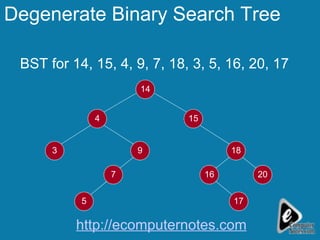
Degenerate Binary Search Tree BST for 14, 15, 4, 9, 7, 18, 3, 5, 16, 20, 17 14 15 4 9 7 18 3 5 16 20 17 http://ecomputernotes.com
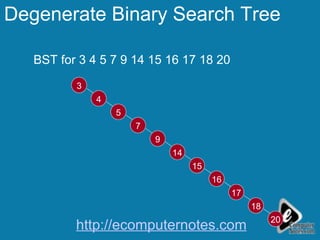
Degenerate Binary Search Tree BST for 3 4 5 7 9 14 15 16 17 18 20 14 15 4 9 7 18 3 5 16 20 17 http://ecomputernotes.com
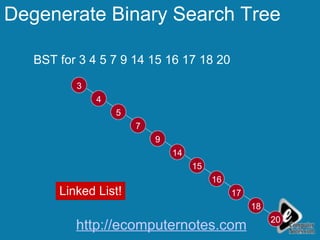
Degenerate Binary Search Tree BST for 3 4 5 7 9 14 15 16 17 18 20 14 15 4 9 7 18 3 5 16 20 17 Linked List! http://ecomputernotes.com
Balanced BST We should keep the tree  balanced . One idea would be to have the left and right subtrees have the same height http://ecomputernotes.com
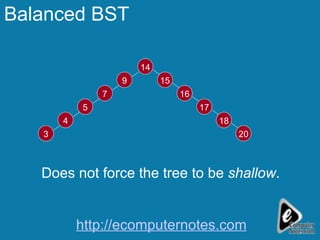
Balanced BST Does not force the tree to be  shallow . 14 15 18 16 20 17 4 9 7 3 5 http://ecomputernotes.com
Balanced BST We could insist that every node must have left and right subtrees of same height. But this requires that the tree be a complete binary tree To do this, there must have (2 d+1  – 1 )   data items, where  d  is the depth of the tree. This is too rigid a condition. http://ecomputernotes.com
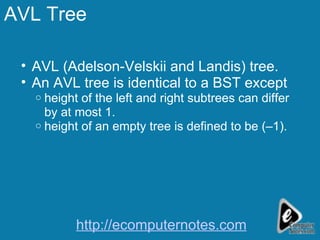
AVL Tree AVL (Adelson-Velskii and Landis) tree. An AVL tree is identical to a BST except  height of the left and right subtrees can differ by at most 1. height of an empty tree is defined to be (–1). http://ecomputernotes.com
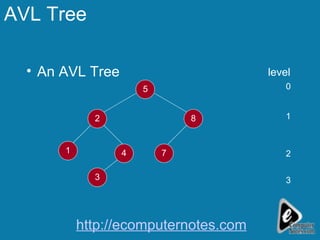
AVL Tree An AVL Tree 5 8 2 4 3 1 7 level 0 1 2 3 http://ecomputernotes.com
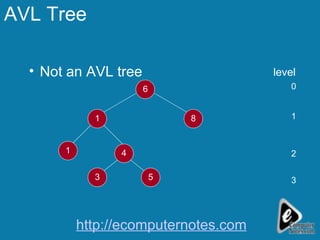
AVL Tree Not an AVL tree 6 8 1 4 3 1 5 level 0 1 2 3 http://ecomputernotes.com
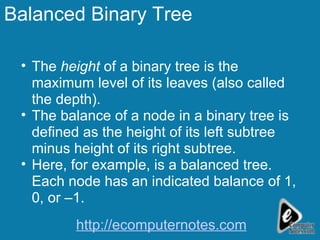
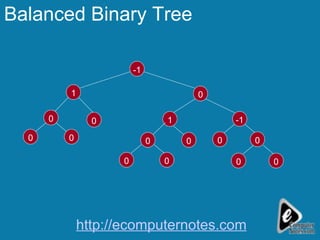
Balanced Binary Tree The  height  of a binary tree is the maximum level of its leaves (also called the depth). The balance of a node in a binary tree is defined as the height of its left subtree minus height of its right subtree. Here, for example, is a balanced tree. Each node has an indicated balance of 1, 0, or –1. http://ecomputernotes.com
Balanced Binary Tree -1 0 1 0 0 0 0 -1 0 1 0 0 0 0 0 0 0 http://ecomputernotes.com

computer notes - Data Structures - 19

  • 1.
    Class No.19 Data Structures http://ecomputernotes.com
  • 2.
    The const KeywordThe answer is that, yes, we don’t want the function to change the parameter, but neither do we want to use up time and memory creating and storing an entire copy of it. So, we make the original object available to the called function by using pass-by-reference. We also mark it constant so that the function will not alter it, even by mistake. http://ecomputernotes.com
  • 3.
    The const KeywordUse 2 : The const keyword appears at the end of class member’s function signature: EType& findMin( ) const; Such a function cannot change or write to member variables of that class. This type of usage often appears in functions that are suppose to read and return member variables. http://ecomputernotes.com
  • 4.
    The const KeywordUse 3 : The const keyword appears at the beginning of the return type in function signature: const EType& findMin( ) const; Means, whatever is returned is constant. The purpose is typically to protect a reference variable. This also avoids returning a copy of an object. http://ecomputernotes.com
  • 5.
    Degenerate Binary SearchTree BST for 14, 15, 4, 9, 7, 18, 3, 5, 16, 20, 17 14 15 4 9 7 18 3 5 16 20 17 http://ecomputernotes.com
  • 6.
    Degenerate Binary SearchTree BST for 3 4 5 7 9 14 15 16 17 18 20 14 15 4 9 7 18 3 5 16 20 17 http://ecomputernotes.com
  • 7.
    Degenerate Binary SearchTree BST for 3 4 5 7 9 14 15 16 17 18 20 14 15 4 9 7 18 3 5 16 20 17 Linked List! http://ecomputernotes.com
  • 8.
    Balanced BST Weshould keep the tree balanced . One idea would be to have the left and right subtrees have the same height http://ecomputernotes.com
  • 9.
    Balanced BST Doesnot force the tree to be shallow . 14 15 18 16 20 17 4 9 7 3 5 http://ecomputernotes.com
  • 10.
    Balanced BST Wecould insist that every node must have left and right subtrees of same height. But this requires that the tree be a complete binary tree To do this, there must have (2 d+1 – 1 ) data items, where d is the depth of the tree. This is too rigid a condition. http://ecomputernotes.com
  • 11.
    AVL Tree AVL(Adelson-Velskii and Landis) tree. An AVL tree is identical to a BST except height of the left and right subtrees can differ by at most 1. height of an empty tree is defined to be (–1). http://ecomputernotes.com
  • 12.
    AVL Tree AnAVL Tree 5 8 2 4 3 1 7 level 0 1 2 3 http://ecomputernotes.com
  • 13.
    AVL Tree Notan AVL tree 6 8 1 4 3 1 5 level 0 1 2 3 http://ecomputernotes.com
  • 14.
    Balanced Binary TreeThe height of a binary tree is the maximum level of its leaves (also called the depth). The balance of a node in a binary tree is defined as the height of its left subtree minus height of its right subtree. Here, for example, is a balanced tree. Each node has an indicated balance of 1, 0, or –1. http://ecomputernotes.com
  • 15.
    Balanced Binary Tree-1 0 1 0 0 0 0 -1 0 1 0 0 0 0 0 0 0 http://ecomputernotes.com

Editor's Notes